News & insightsPress release
Crescent Regional Hospital becomes the first US hospital to use hologram technology for remote doctor-patient consultations
Crescent Regional Hospital in Lancaster, Texas partners with Holoconnects to bring life size holographic doctor-patient consultations to American healthcare, the first US hospital to deploy the Holobox in clinical use.
Published 28 May 2024
AMSTERDAM and LANCASTER, TEXAS, May 28, 2024. Crescent Regional Hospital, an acute care hospital less than an hour south of Dallas, and Holoconnects announced a partnership that makes Crescent Regional Hospital the first in the U.S. to utilise life size holographic technology for patient care.
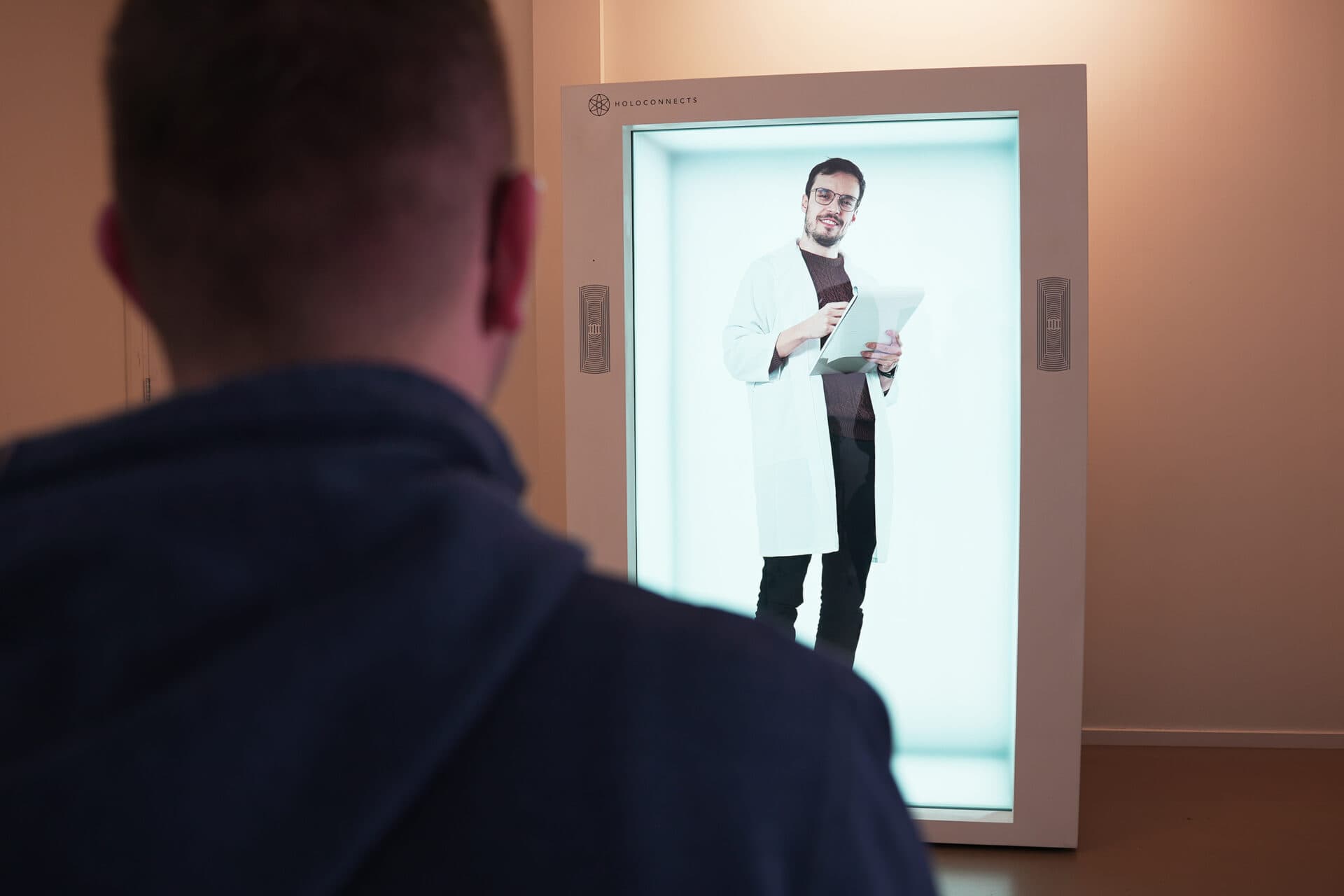
The integration of Holoconnects' Holobox technology enables doctors to teleport as a life size 3D hologram and connect with patients in real time, transforming communication between doctor and patient and creating an immersive, engaging interactive experience.
The deployment
Crescent Regional Hospital has installed its first full-size 86" Holobox hologram display and video studio, and plans to install 24" Holobox Mini displays at several locations throughout the hospital and associated clinics. Crescent Regional is on a mission to become the "hospital of the future", combining technology and human ingenuity to break down historical barriers to superior healthcare access, including underserved communities.
Patients can now schedule a non-touch visit with their doctor or any range of medical specialists, from the Dallas area or anywhere in the world.
From the CEO
"Teleporting our doctors in real time to connect and speak with our patients from any location as a life size hologram gives our patients access to the healthcare they deserve, and also saves our doctors one of the most precious resources they have, time, enabling them to see as many patients as possible," said Raji Kumar, CEO and Managing Partner of Crescent Regional Hospital. "Integrating Holoconnects' Holoboxes within our hospitals will shorten wait times, increase access to specialist care, and improve patient care across multiple disciplines."
Use cases
Virtual consultations pre- and post-surgery across Crescent's specialties including cardiology, emergency care, gastroenterology, neurology, orthopaedic care, pulmonology, general surgery, spine health, and wound care.
Telemedicine rounds. Doctors can conduct "virtual" rounds with patients and hospitalists to discuss treatment plans and progress, and save the time it takes them to travel by car between patient locations.
Physician/specialist consultations. Patients can access Crescent Regional Hospital specialists remotely, opening up more availability for the physician and eliminating weeks or months of wait time for the patient. Doctors save up to 20 hours a week, enabling them to see more patients and address urgent cases.
Patient education. Holograms can help educate patients about their medical conditions, treatment options, pre-surgery instruction, and post-discharge care instruction. Patients are comfortable interacting with holograms, it feels like seeing a doctor in person.
 Sector insight
Hologram solutions for healthcare
Holograms give patients clearer information, give clinicians presence across distance, and extend the reach of specialist care, at hospital, clinic, and pharmacy scale.
Read the article Press
El Confidencial, the holographic doctor
El Confidencial profiles holographic care from Crescent Regional Hospital to a future where AI driven holograms support astronauts on long-duration space missions.
Read the article Sector insight
Hologram doctors vs healthcare shortage
The global shortage of healthcare workers is forecast to reach 10 million by 2030. Holographic specialists let one clinician serve many sites, without travel, without delay.
Read the article